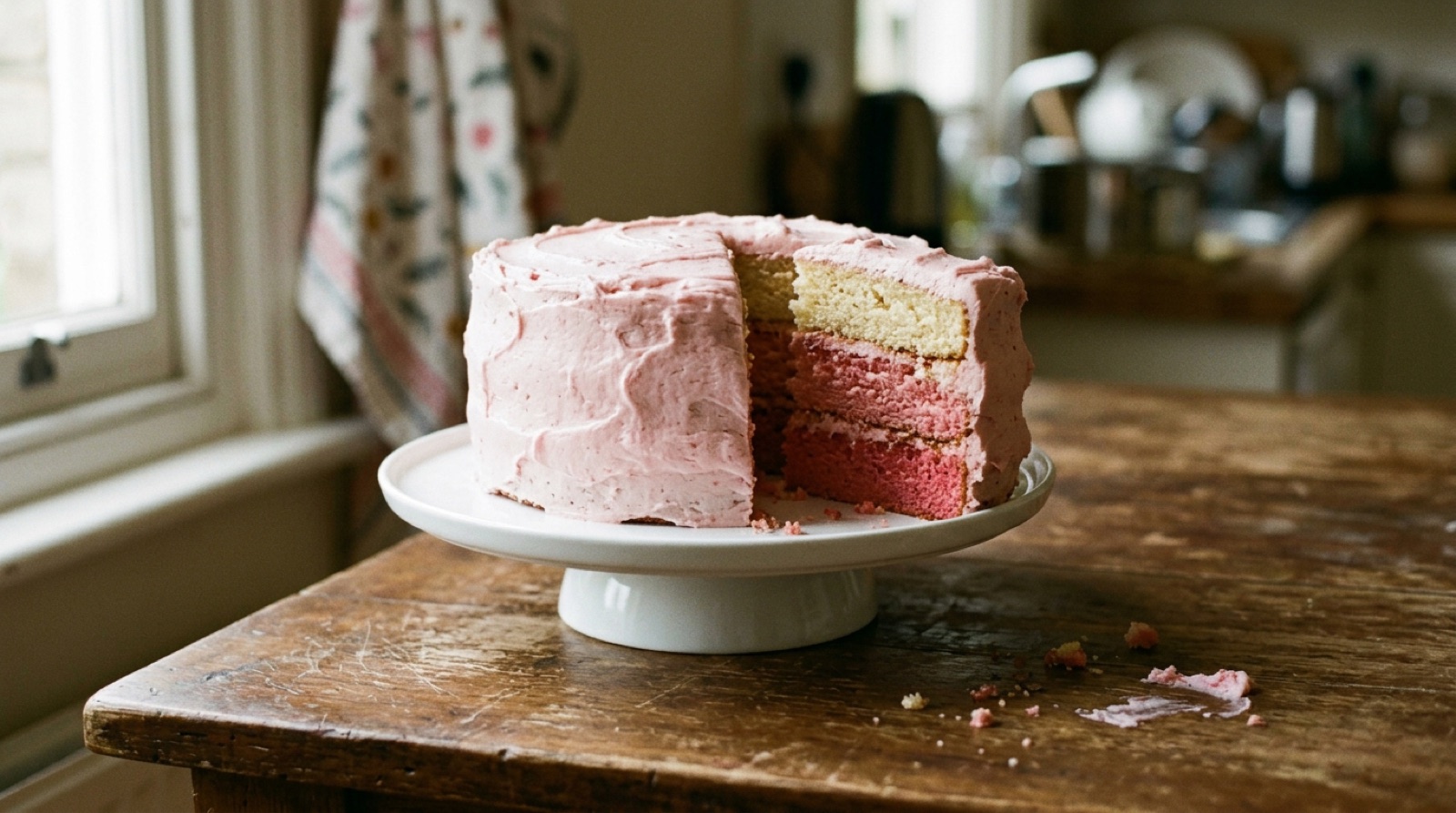
Princess Birthday Cake
A princess cake is a pink cake that has to survive a party. It gets carried to a table, photographed, and cut by somebody who has never cut a cake before, usually in a warm room. So the two things that matter are a crumb that stays soft for a couple of days and a buttercream that holds a swirl at room temperature.
This is a three-layer vanilla cake, graded from deep pink at the bottom to plain at the top, so the slices look deliberate when they come apart.
Why this method works
Most vanilla cakes are creamed: butter and sugar whipped together, then eggs, then flour. That builds a lot of air and a slightly coarse crumb that stales fast.
This uses the reverse creaming method instead. The butter is rubbed into the dry ingredients first, which coats the flour in fat before any liquid arrives. Less gluten forms, so the crumb is finer, flatter on top, and still soft on day two. It is also much harder to overmix, which matters when you are baking around a birthday.
Ingredients
For the cake:
- 340g plain flour
- 400g caster sugar
- 1 tbsp baking powder
- 1 tsp fine salt
- 225g unsalted butter, softened but still cool
- 4 large eggs, at room temperature
- 240ml whole milk, at room temperature
- 1 tbsp vanilla extract
- Pink gel food colouring
For the buttercream:
- 450g unsalted butter, softened
- 900g icing sugar, sifted
- 60ml double cream
- 2 tsp vanilla extract
- Pinch of salt
Method
-
Prepare the tins. Heat the oven to 180C (160C fan, gas mark 4). Butter three 20cm round tins, line the bases with baking paper, then dust the sides with flour and tap out the excess.
-
Mix the dry ingredients into the butter. Whisk the flour, sugar, baking powder and salt in a stand mixer on low. Add the softened butter a few cubes at a time and beat until it looks like damp sand with no loose flour.
-
Add the wet ingredients. Whisk the eggs, milk and vanilla together. Pour in a third and beat on medium for 90 seconds, which is where the structure comes from. Add the rest in two additions, mixing only until smooth, and scrape the bowl.
-
Colour the batter. Divide between the tins. Leave one plain, tint one pale pink, and take the third a few shades deeper. Fold the gel in by hand so you do not knock the air out.
-
Bake for 26 to 30 minutes. The centre should spring back and a skewer should come out with a few damp crumbs rather than clean. Cool in the tins for 10 minutes, then turn out and cool completely. Warm cake will melt buttercream on contact.
-
Make the buttercream. Beat the butter alone for a full 5 minutes until it is noticeably paler. Add the icing sugar in three additions, then the cream, vanilla and salt, and beat 3 minutes more.
-
Assemble. Level the domes with a serrated knife. Stack darkest to lightest with buttercream between the layers. Do a thin crumb coat first and chill it for 20 minutes, then finish with the rest and swirl the sides.
Getting ahead
The layers keep well. Bake them up to two days early, wrap each one in cling film once completely cool, and keep them at room temperature. Buttercream can be made three days ahead and refrigerated, but bring it back to room temperature and re-whip for two minutes before using or it will tear the cake.
Common problems
The buttercream is soupy. The butter was too warm, or the kitchen is. Chill the whole bowl for 15 minutes and re-whip. It comes back.
The layers domed badly. The oven is running hot. Check it with an oven thermometer, and see the oven temperature chart if you are converting from a recipe written for a different oven type.
The colour baked out pale. Liquid colouring fades in the oven and thins the batter. Gel holds.
No buttermilk, no double cream, no caster sugar? The substitutes finder has ratios for each, and the gram-to-cup converter handles the measurements if you are working from cups.